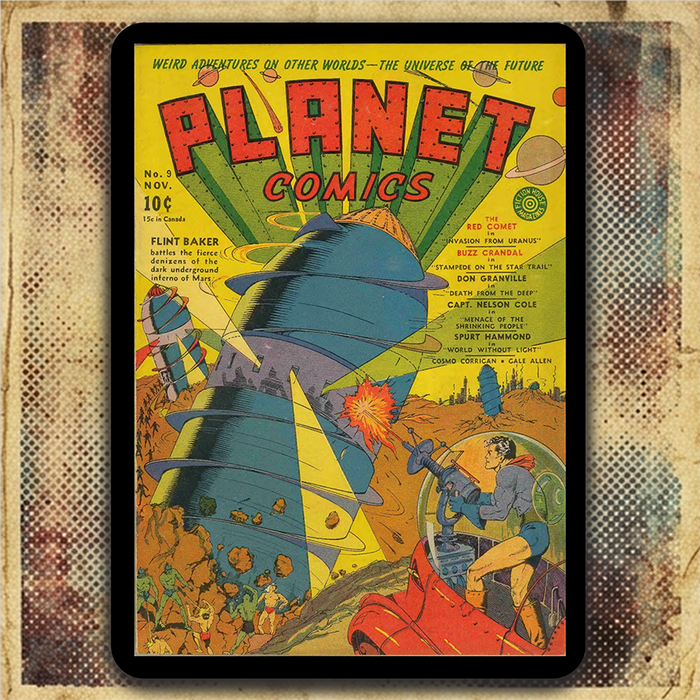
Planet Comics #9 (November 1940)
Planet Comics #9, published by Fiction House with a cover date of November 1940 (hitting newsstands around September), is a classic relic from the Golden Age of sci-fi comics. This series was the premier space opera of its era—vibrant, slightly bizarre, and packed with “Good Girl” art (the period’s distinctive style featuring adventurous, action-ready heroines) and wild interplanetary adventures.
What Makes This Issue Notable
Cover Artist
The striking cover was illustrated by Bob Powell. It features a classic space-hero aesthetic with vibrant colors and high-stakes action typical of the era—a perfect snapshot of 1940s pulp sci-fi imagination.
The “Hanks” Factor
One of the most sought-after aspects of early Planet Comics issues is the work of Fletcher Hanks, writing here under the pseudonym “Carlson Merrick.” Hanks is a cult favorite among collectors for his surreal, almost fever-dream-like storytelling and unique, rigid art style. In this issue, he provides a Buzz Crandall story that showcases his distinctive creative vision.
Primary Stories
-
The Red Comet: A magical space superhero (this issue features “The Stickers”)
-
Auro, Lord of Jupiter: A Tarzan-like figure transplanted into a sci-fi setting
-
Flint Baker: One of the mainstays of the series, featuring “Invasion of the Cyclops-Men of Mars”
-
Spurt Hammond: Defending Venus against the “Rock Men of Jupiter”
Collector’s Value
Because Fiction House comics were printed on high-acid paper, finding copies in high grade is notoriously difficult. Most surviving copies are in low to mid-grade condition (Good to Fine range), making high-grade examples exceptionally valuable. The combination of Fletcher Hanks content, Bob Powell artwork, and the scarcity of well-preserved Fiction House titles makes this issue particularly desirable to Golden Age collectors and pulp sci-fi enthusiasts.
This issue represents not just a comic book, but a time capsule of pre-war American pop culture’s vision of space adventure—wild, imaginative, and utterly unique to its era.

Go Figment
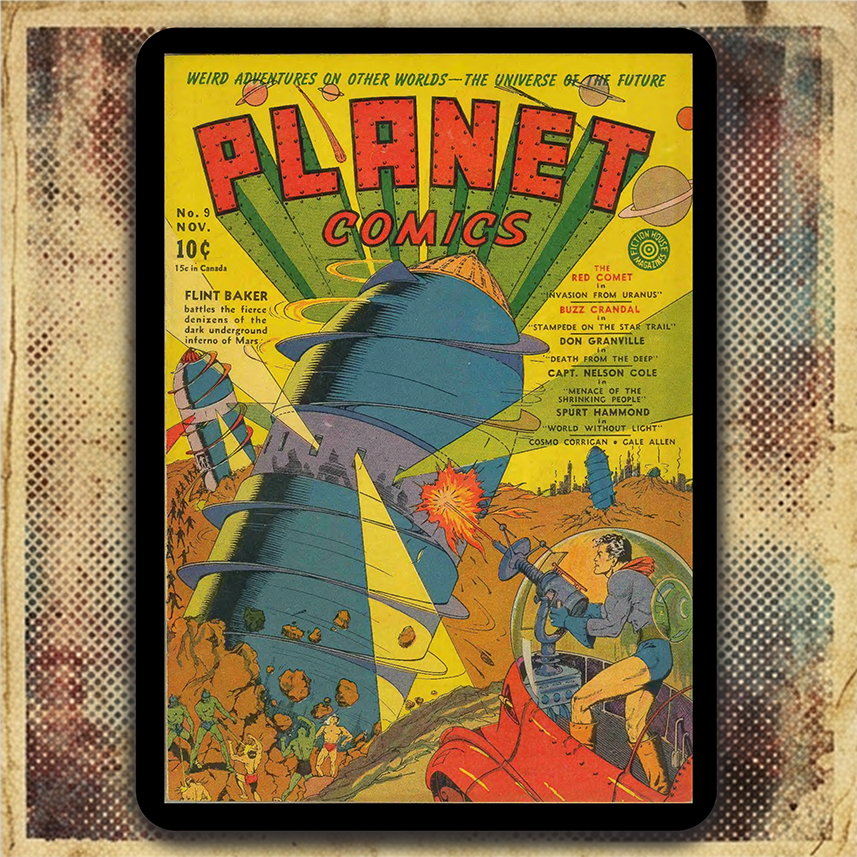
Planet Comics #9 (November 1940)
Planet Comics #9 (November 1940)
Planet Comics #9, published by Fiction House with a cover date of November 1940 (hitting newsstands around September), is a classic relic from the Golden Age of sci-fi comics. This series was the premier space opera of its era—vibrant, slightly bizarre, and packed with “Good Girl” art (the period’s distinctive style featuring adventurous, action-ready heroines) and wild interplanetary adventures.
What Makes This Issue Notable
Cover Artist
The striking cover was illustrated by Bob Powell. It features a classic space-hero aesthetic with vibrant colors and high-stakes action typical of the era—a perfect snapshot of 1940s pulp sci-fi imagination.
The “Hanks” Factor
One of the most sought-after aspects of early Planet Comics issues is the work of Fletcher Hanks, writing here under the pseudonym “Carlson Merrick.” Hanks is a cult favorite among collectors for his surreal, almost fever-dream-like storytelling and unique, rigid art style. In this issue, he provides a Buzz Crandall story that showcases his distinctive creative vision.
Primary Stories
-
The Red Comet: A magical space superhero (this issue features “The Stickers”)
-
Auro, Lord of Jupiter: A Tarzan-like figure transplanted into a sci-fi setting
-
Flint Baker: One of the mainstays of the series, featuring “Invasion of the Cyclops-Men of Mars”
-
Spurt Hammond: Defending Venus against the “Rock Men of Jupiter”
Collector’s Value
Because Fiction House comics were printed on high-acid paper, finding copies in high grade is notoriously difficult. Most surviving copies are in low to mid-grade condition (Good to Fine range), making high-grade examples exceptionally valuable. The combination of Fletcher Hanks content, Bob Powell artwork, and the scarcity of well-preserved Fiction House titles makes this issue particularly desirable to Golden Age collectors and pulp sci-fi enthusiasts.
This issue represents not just a comic book, but a time capsule of pre-war American pop culture’s vision of space adventure—wild, imaginative, and utterly unique to its era.