

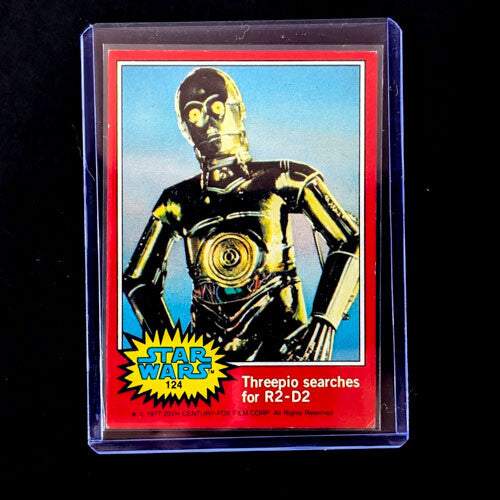
1977 Star Wars Trading Cards: My Childhood Collection Revealed

A journey through time and space, exploring the iconic collectibles that captured the magic of a galaxy far, far away
Introduction
Star wars trading cards from 1977 represent more than just pieces of cardboard with movie images — they're time capsules from the birth of a cultural phenomenon. When I recently rediscovered my childhood collection tucked away in my parents' attic, memories came flooding back of rushing to the corner store with allowance money clutched tightly in hand, eagerly tearing open those wax packs, and inhaling that distinctive bubble gum scent.
What started as Topps taking a modest gamble on an unproven sci-fi film turned into one of the most iconic collectible series ever produced. The original 1977 Topps Star Wars cards, with their distinctive colored borders and behind-the-scenes glimpses, captured moments from a galaxy far, far away before VHS tapes or DVDs existed.
How the 1977 Star Wars Cards Came to Be
The road to creating what would become one of the most iconic collectible series began with rejection. Donruss actually had the first opportunity to create Star Wars trading cards. As part of the Kenner family that secured the toy license, Donruss had first rights to produce cards for the film—but they declined.
Topps' gamble on a new sci-fi film
Surprisingly, even at Topps there was significant hesitation about pursuing the Star Wars license. The 1970s had seen several unsuccessful non-sport card releases, including their 1976 Star Trek set. Science fiction properties were considered risky investments in the trading card world, and movie-based cards were especially dangerous—if the film flopped, so would the merchandise.
The five series and their unique border colors
Once Star Wars exploded in popularity after its May 25, 1977 release, Topps quickly capitalized by releasing five distinct series of cards throughout 1977 and early 1978:
- Series 1 (Blue Border): Cards #1-66, released in June 1977, featuring the first appearances of major characters including Luke Skywalker (#1), Princess Leia (#5), and Darth Vader (#7)
- Series 2 (Red Border): Cards #67-132, showcasing additional film stills and some deleted scenes
- Series 3 (Yellow Border): Cards #133-198, introducing "Official Description" write-ups on the backs
- Series 4 (Green Border): Cards #199-264, continuing the encyclopedia-style backs and containing the infamous C-3PO "error card" (#207)
- Series 5 (Orange Border): Cards #265-330, focusing more on behind-the-scenes imagery
My Favorite Cards from the Collection
Digging through my childhood collection recently, five cards stood out as particularly special, both for their personal meaning and their remarkable place in collectible history. These standouts capture the essence of what made the original 1977 Star Wars cards so magical—iconic characters frozen in time on those distinctive blue-bordered rectangles.

Luke Skywalker #1
The Luke Skywalker #1 card remains the crown jewel of any vintage Star Wars collection. This historic card recently shattered records when a PSA 10 example sold for a staggering USD 268,400 at Heritage Auctions.
What makes this card so valuable is its extreme rarity in pristine condition—out of more than 4,600 graded copies, only nine have achieved the coveted Gem Mint 10 rating.

C-3PO #207
Perhaps no Star Wars card is more notorious than the "Golden Rod" C-3PO error card. This Series 4 green-bordered card (#207) features what appears to be an anatomical appendage extending from C-3PO's lower region.
For years, collectors debated whether it was an intentional prank or an unfortunate coincidence. Topps quickly corrected the error, making original versions highly sought after by collectors.
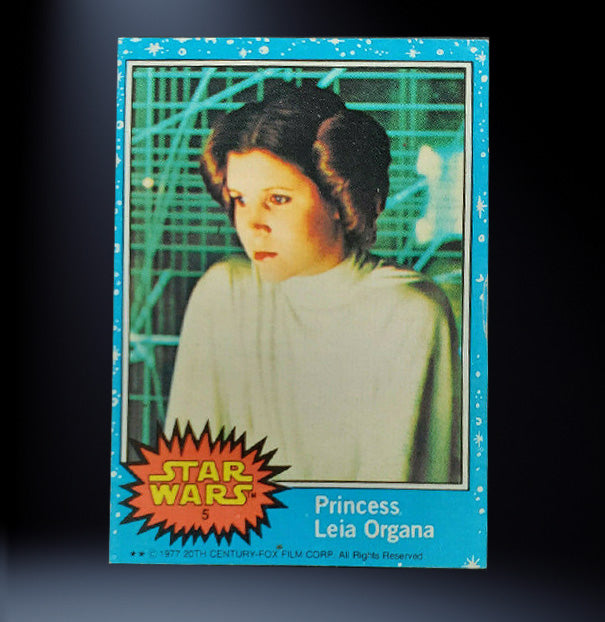
Princess Leia #5
One of the most sought-after cards from the original blue series, featuring the iconic princess in her most recognizable look from the opening scenes of the film.
This card captures the moment that launched one of cinema's most beloved characters and remains a cornerstone of any serious Star Wars card collection. The blue border framing this historic image makes it especially prone to showing wear.
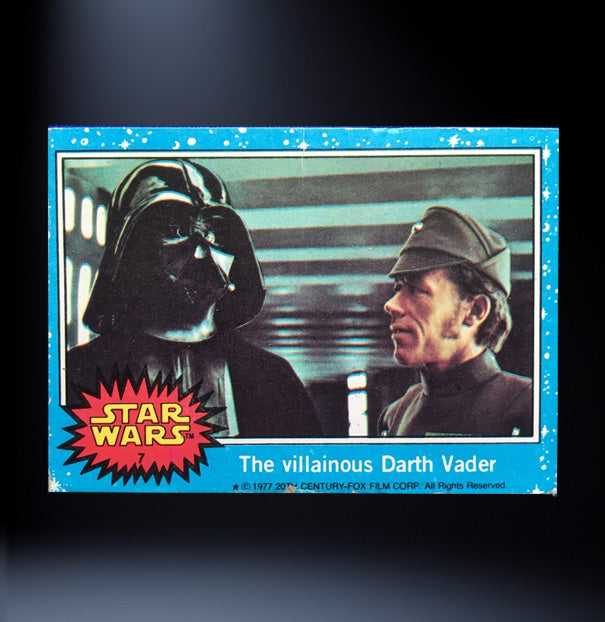
Darth Vader #7
This early appearance of cinema's greatest villain has become one of the most iconic trading cards in collecting history. Card #7 captures Vader in all his menacing glory, establishing his presence immediately in the collection.
Like other blue border Series 1 cards, finding this Vader in pristine condition is extremely challenging due to the border's tendency to show wear, chipping, and fading over time.
What Made These Cards So Special
Beyond their cultural impact, the physical characteristics of Star Wars trading cards made them extraordinary collectibles. The cards themselves weren't merely pictures from a movie—they were meticulously designed objects with features that continue to fascinate collectors decades later.
Puzzle backs and sticker inserts
One of the most ingenious aspects of the 1977 Topps Star Wars cards was how they encouraged continued purchasing through puzzle backs. Each series contained multiple puzzles spanning numerous cards. Series 1 featured two distinct puzzles—a 28-card illustration by Topps artist Augie Napoli (also used for box art) and a 16-card image showing the Millennium Falcon cockpit with Han, Chewie, Luke, and Obi-Wan.
The fragile blue borders and condition rarity
The distinctive blue borders of Series 1 became both their signature feature and their greatest vulnerability. These star-flecked blue frames chipped and faded easily, making pristine examples exceedingly rare. Even minor handling caused visible wear, a situation exacerbated by the fact that children in 1977 treated these as toys rather than investments.

The Market Value of My Childhood Cards Today
Looking up the current prices for my childhood Star Wars trading cards felt like discovering buried treasure in my own home. What once cost mere pennies per pack now commands staggering sums in today's collector market, underscoring how these nostalgic pieces have transformed from playthings to investments.
How grading affects value
In the realm of 1977 Topps Star Wars cards, condition means everything. The difference between grades can add several zeros to a card's price tag. Near mint cards (PSA 8) typically fetch around USD 1,350, yet just two grades higher, a gem mint 10 can command USD 25,000 or more. This dramatic price escalation occurs because pristine examples are incredibly scarce.
Recent record-breaking sales
The Star Wars card market has seen astonishing growth. A Luke Skywalker #1 PSA 10 shattered records in 2023, selling for USD 268,400 at Heritage Auctions. This obliterated its previous high of USD 78,000 set just months earlier. Remarkably, the same card sold for merely USD 311 in 2015.
Conclusion
Time capsules from 1977 sit before me now, transformed from simple childhood playthings into valuable artifacts of pop culture history. These Star Wars trading cards represent far more than their monetary worth—they embody the beginning of my lifelong passion for a galaxy far, far away.
Looking back at my collection reveals the brilliance of Topps' marketing strategy. Those colored borders, puzzle backs, and rare stickers created the perfect collecting storm that kept kids like me spending allowance money week after week. The blue-bordered Series 1 cards, particularly fragile and susceptible to damage, now command astronomical prices precisely because we never treated them as investments.
Almost half a century later, these trading cards remain powerful artifacts from the birth of a cultural phenomenon. Though bent corners and bubble gum stains may have diminished their market value, the memories they evoke remain priceless. Star Wars cards weren't just something we collected—they were how many of us first truly experienced and preserved the magic of that original film, one pack at a time.
Complete your collection with Go Figment






Leave a comment